As mentioned in ‘Where Should I Invest?‘ a portfolio is simply a combination of assets. This can be a combination of the same type of asset i.e. 5 stocks, or a multi-asset portfolio i.e. 3 stocks, 2 bonds, and 1 property. These assets can be weighted/combined in a number of ways (see below).

An illustration of an equally weighted stock portfolio and unequally weighted multi-asset portfolio.
Equal weight is an easy to understand method where each asset is held in proportion to the others. More complex weighting methods exist, such as market-cap weighted (FTSE 100), price weighted (Dow Jones). However, the most interesting weighting schemes involve optimisation i.e. building a risk-adjusted portfolio (we will cover this in Portfolio Construction: Part 2).
As a Joe Public investor, you are likely to have an unequal weight, multi-asset portfolio. Your savings are often in cash (hopefully not…’Participation is Key’.), your pension is typically a combination of equities and bonds and you are likely have invested in residential property via a mortgage. As a result, it is extremely beneficial to understand the characteristics of a multi-asset portfolio… after all, you have one!
You need not worry… there are good reasons as to why investors construct multi-asset portfolios. In ‘Where Should I Invest?’ we compared only the risk/return relationship between major asset classes – there are a number of other elements investors may be interested in controlling. By combing assets to their individual needs every investor is able to limit their exposure to undesirable characteristics. The most popular attributes are summarised below;
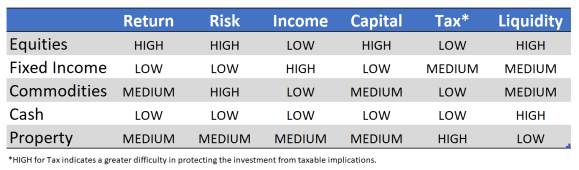
Table summarising key characteristics of major asset classes.
Just as an example… the Average Joe holds cash because it allows them to be ‘liquid’ (have physical money i.e. spending money, on demand), have a company pension plan which is loaded up with equities (because they hope for long term capital growth) and if they are lucky enough they let residential property as they expect to benefit from the monthly income and long term price appreciation. As you can see from the chart above, these three assets all behave quite differently and as a result they create a very popular and effective portfolio.
 Portfolio Advice for Joe Public