Month: June 2018

So… You’re an Average Joe.

So… You’re an Average Joe and you’re looking to invest. So how do you do it?! Well, we have all been there. It is a confusing a difficult problem. Your parents are telling you to do one thing, your partner another, and your friends well… something completely different. And thats not to mention the rogue colleague who has been trying to persuade you to invest all your life savings in Cryptocurrencies either! You have tried to Google ‘How to invest’… but you ended up with more questions than answers. So what do you do next? Well, that is exactly what I am here for!

The purpose of this post blog is to walk you through the journey of becoming an investor. We start at the very beginning, with no prior investment knowledge, and conclude with you being an actual investor – in the real world! All the advice contained in Public Portfolio is completely independent. Examples will be practical and terminology kept to a minimum.

Lets begin…!

Step 1 – Escaping No Mans Land

You are unsure what investing actually means. You understand the concept and know you want to be an investor, but that is about it. You are not sure what your first step should be. Well… lets start from the beginning!

  • What does it mean to invest and why should you do it?
  • What are your investment goals & objectives? What is your risk tolerance?
  • What are the things I can invest in? How do they help me meet my goals and objectives?

So your sold on the idea of investing and have some idea of what kind of investor you want to be. You have a good understanding of what the major asset classes are and which ones suit you the most. What is next?

Step 2 – Learning Your Trade

The next step is to learn your trade. In this section we acquire the necessary skills to become an investor by exploring how things work in the real world. This is where it starts to get interesting…

  • What are your options?
  • How does investing work in reality?
  • Self-Invested ISA vs Managed ISA – which should you choose?

You now understand how you want to invest in practical terms. Lets make it happen.

Step 3 – Entering the Battle

This is where we open an account. Get your cheque book ready!

  • How to open an investment account
  • What to think about next

Congratulations – you have now graduated to an Above Average Joe! Your money is now working for you 24/7! You are earning whilst you eat, sleep and work. But it doesn’t end here…

What’s next?

If you decided to take the burden of investing on your own two shoulders, or are simply curious about learning more, then this next series is for you! We will explore all the complexities of running your own portfolio as an Above Average Joe.
Portfolio Construction: Part 3 – Correlation

So far in this ‘Portfolio Construction’ series we have introduced the idea of a portfolio, summarised how different assets classes behave and concluded that we are likely all owners of a multi-asset portfolio (Part 1). We then moved on to show how combining assets is beneficial to an investor by both increasing returns and reduce risk (Part 2). In this post we will talk through the underlying mechanics of how combining assets has a positive impact… correlation.

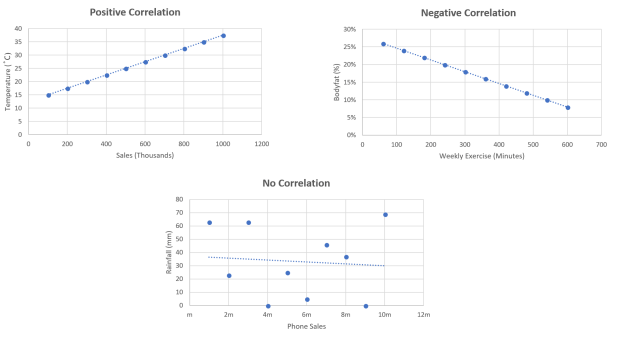
Lets start with some definitions and simple examples: Correlation – a relationship or connection between two or more things. Examples: sunny weather and ice cream sales, time slept and energy throughout the day. These examples both show positive correlation i.e. they both rise together. A negative correlation, when one thing goes up, the other goes down, is still a relationship and can be very strong one i.e. smoking and lung capacity, exercise and body fat (although some might not agree this has a strong correlation!). Finally, we also have a low/no correlation, mobile phone sales and rainfall… they will have no impact on one another. Correlations are measured mathematically on a scale of -1 to 1, 1 meaning a strong positive correlation, -1 a strong negative and 0 representing no correlation. You can see graphical examples of these below.

Illustrative Correlations with Trendline

Lets link all of this back to investing. When thinking about a portfolio, correlations are important because a portfolio of highly correlated assets would all do well together, or do poorly together. Most investors would rather have a smooth journey i.e. a portfolio that slowly climbs over time, than something that swings between making and losing you lots of money. 

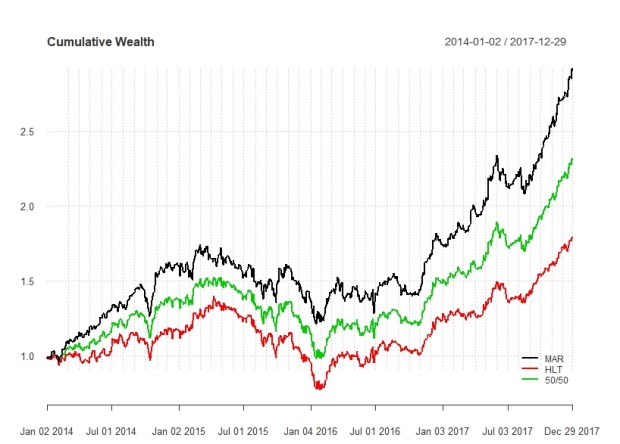
Imagine you had all your savings in Marriott and Hilton, two luxury hotel companies, your portfolio would have performed like the below…

Marriott and Hilton

Cumulative performance of Marriott, Hilton and a 50/50 portfolio

You can see from the chart that the pattern between the two companies returns is almost identical, when one of these stocks performs well, so does the other, when one performs badly so does the other. Combining these two stocks, offers little difference in the observable pattern. Contrast this to the example we looked at in Building a Portfolio which you can see again below.

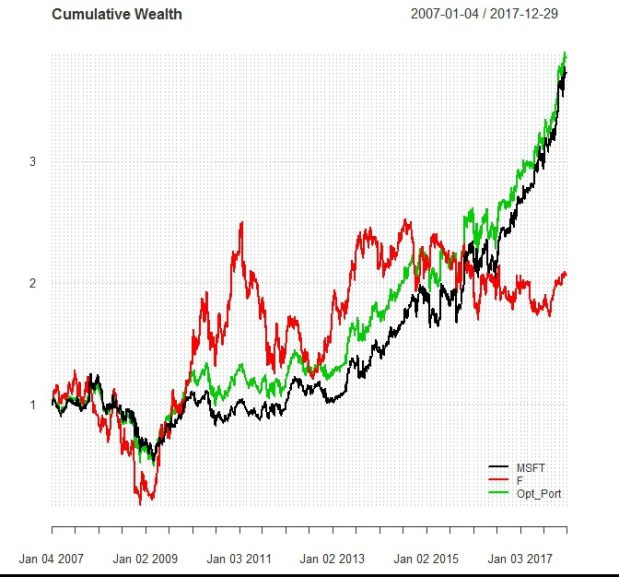
Opt Port

Cumulative performance of Microsoft, Ford and an Optimized Portfolio of both

As you can see, it is clear that the relationship between Marriott and Hilton is much closer than the relationship between Microsoft and Ford. This is reflected in the correlation numbers which are 0.73 and 0.4 for each pair, respectively.

By combining two things which are highly correlated you create a portfolio which is highly correlated to the original two things – the benefit of doing this is minimal. You can see by looking at the first chart you are better off having invested in just Marriott than buying Hilton or both. This is in contrast to Microsoft and Ford, where the combination was something different, and actually performed better than both the individual stocks. This was evidenced in the Sharpe Ratio which was 0.46 for Microsoft, 0.15 for Ford, and 0.49 for the combination. Marriott and Hilton have a Sharpe Ratio of 1.41 and 0.68 respectively. However when combining the two the Sharpe Ratio falls to 1.12 – lower than just holding Marriott.

OK… so why is this important to consider? When constructing a portfolio it is important for investors to consider their portfolio as a whole, and not each investment in isolation. If your best ideas happen to be 5 energy stocks… they might be great ideas on their own, and they might do very well for you… until the oil price crashes and they all come tumbling down at once. By looking at the correlation between the assets within a portfolio, investors can better avoid unknowingly putting all their eggs in one basket!