The Basics

What does Investing Mean, and Why Should You Do It?

This is an easy one.

‘What does it mean to invest?’. To invest is to commit money (or resource) in order to gain a financial reward or future advantage. Some examples of investing are; buying property, purchasing stocks or reading a book. All of these actions require money or resource i.e. time and energy and are conducted for some form of future return such as owning a home, financial profit or extra knowledge. The problem is we all have limited resources and thus must be efficient in how we spend them. The aim is to extract the most value you possibly can out of every pound or minute invested. Whilst I fully believe everyone should invest as much as they can into their passions, family and friends… these topics are far too complex for me! As a result, I will focus purely on how one should invest for financial reward.

Financial investing is the process of making your money make you money, or ‘putting your money to work’. However doing this is not easy or simple. In reality investing for the future is risky, complex and demanding. The future is not certain and nothing is guaranteed – although over the long term asset prices (houses and stocks) do tend to rise, short term shocks like the 2008-2009 recession can and do happen. Investing is also complex and requires education in order to ensure correct decisions are being made by investors and that investments can be monitored and understood going forwards. Above all, investing requires courage. Making a decision to put all of your hard-earned savings into an investment outside of your control requires enough courage to trust in what you are doing and requires the discipline to not panic when things inevitably go through a bumpy patch. Investing is not smooth sailing. If it was… everybody would be doing it… and if everyone was doing it, it wouldn’t be worth it!

You might currently be thinking that financial investing sounds like too much effort, and that it probably is not worth it. Allow me to prove to you that it is! If you are not investing you likely doing either one of two things, spending all your earnings, or saving as much of them as you can. It is relatively simple to explain the issues with living paycheck to paycheck – you will not be able to cope well with unexpected expenditures, you will have to put your life on hold if you lose your job and lastly, you will have nothing to live off for retirement. Now lets assume your a saver, which is a very good thing to be, you may be fine when unexpected bills come by, or when your temporarily out of work, and if you have saved very well you may even survive retirement. An investor is someone who can do all of that, and then some. The chart below shows the difference between someone who kept £10,000 in a savings account over the last 20 years versus someone who invested the same amount over the same time period.
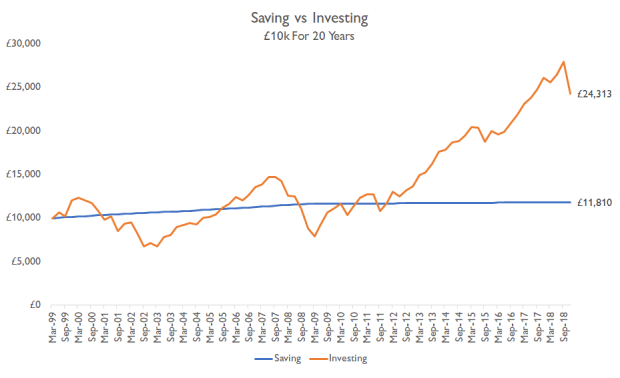
Investing would have made your same £10k worth over double the initial amount, and +£12k more than if it was kept in a savings account over the same time period. Now does investing seem worth it?

To conclude: Investing means to commit money (or resource) in order to gain a financial reward or future advantage, and one should invest because the rewards can be far greater than the alternatives over time. 

Participation is Key

‘You have to be in it to win it’. A crude but very relevant adage for how an investor should think.

The benefits of participation can be made clear with a simple, real world, example of how savings have typically performed versus equities. I use this example because most people that do not ‘participate’ are keeping all their savings in cash at the bank. It’s an easy thing to do… you are paid in cash, your outgoings are in cash, you simply require cash. This is perfectly acceptable and every portfolio should consist of some – but holding 100% of your savings in cash at the bank is costing you money!

Lets assume 5 years ago you had saved £50,000 and have not added a penny since. All that dough in a high interest savings account* would have approximately earned you £3,774… in total. That’s a meagre £755 a year for having £50,000 in savings. If you had instead invested your £50,000 into stocks, say the FTSE 100, you would have made more than £755 in your first year. In fact, the first 12 months (running from September to August 2013) would have made you £6,140! – over 1.5x what you would have made from saving cash for the last 5 years!! In total your 50k would have grown to £65,049 bringing you much closer to meeting your long-term investment objectives, whatever they may be.

This isn’t a new or unusual phenomenon. Equity markets offer a greater return (premium) over cash but at a greater risk. The below chart illustrates the example we have just walked through. As you can see market participation (investing) is not all smooth sailing… but with a long time horizon it is often worth it.

*I assumed all savings were held in a number of leading Cash ISA’s over the entire period. Most savers to not take advantage of Cash ISA’s and instead keep their savings in low interest current accounts. These savers would have experienced even lower cash returns than I have used in my example.

Where Should I Invest?

During ‘ISA is King!’ I spoke about the variety of different ways in which members of Joe Public can invest. I concluded that in most cases the average investor should make use of their ISA because they are very easy to set-up, low-cost and are tax-efficient. However, an ISA is just a tax wrapper, it is not an investment of any kind. To take advantage of an ISA you must first invest.

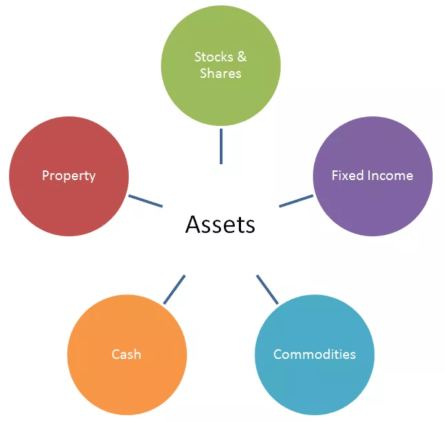
Lets start by considering your options;

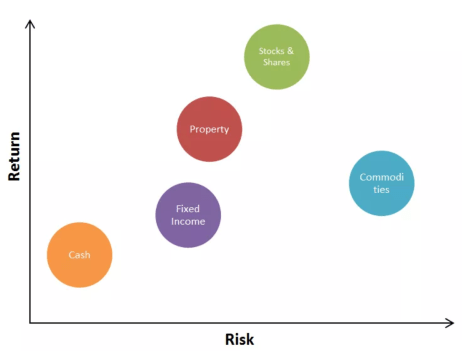
These assets all behave in different ways and so depending on your objectives you may want to invest in one over the other. Two simple and important characteristics to considers are risk and returns. As an investor you want to invest in an asset which gives you the highest possible return for the lowest amount of risk. Here is how these assets typically stack up.

A low risk individual would be interested in Cash, however as you can see, leaving your money in cash is not going to make you rich. An investor who is more willing to take risks to make some dough might consider Stocks and Shares (Equity) e.g. Apple Inc.

Over the long run, investing in Stocks and Shares is the best way to grow your investments and make £££. However, by combining a few of the assets above – i.e. creating a portfolio – an efficient trade-off between risk and return can be reached. By combining assets in a particular way, every investor can create a portfolio which suits their personal investment objectives.

In future I will detail the process of effectively combining assets into a portfolio – ‘Portfolio Construction’.

ISA is King!

As retail investors our investible universe is limited. The most attractive forms of investing for us are; ISA, pension, property, spread betting/CFDs, and entrepreneurial activity. There are more abstract views I could take such as education (‘investing’ in yourself), or gambling (using arbitrage betting strategies) – I will ignore these for now.

OK so with this in mind… I will (and I think you should) focus on investing in an ISA.

Firstly, what is an ISA? An ISA is a tax-free wrapper courtesy of the government. You can make investments inside an ISA, or outside an ISA. The only difference is that investments made inside an ISA are perpetually isolated from tax. To stop people putting all of their savings away in this tax free wrapper, you are capped at £20k annually. To invest ‘in’ an ISA you simply open an account with one of the many large and reputable ISA account providers.

Why?

  1. Investing in a an ISA is near cost-less and setting one up can be done in a day or less
  2. Lower risk than other investments which rely on borrowing money (such as buying a property with a mortgage)
  3. Your much more likely to make money by investing in an ISA than leaving your cash in a savings account
  4. Investments in an ISA are tax free. Literally… ZERO tax!

The benefit of not paying tax on investment gains is meaningful. Here’s an example below.


Note: This assumes an investor utilises their full ISA allowance every year which is currently £20,000.

After Year 5 the benefit is over £1,000 and by Year 10 you would have saved over £20,000 on your tax bill. As you’ll notice by looking at the ‘ISA Benefit’ column, the benefit rises every year and for long term investors this could grow to be even more substantial. The example above is reasonably conservative too… higher return assumptions would have magnified the benefit from having invested in an ISA. A portfolio with an expected capital gain of 10% would be £36,000 better off after 10 years!! It is also worth remembering that tax laws are subject to change and could be even higher in future. Any money locked away in an ISA is always isolated from tax.

Finally, and most importantly, an ISA is free and easy to set-up. The cost is zero and the benefit is £££! Regardless of what your savings goals may be, an ISA can help you reach them quicker… So, what are you waiting for?!

What Type of Investor are You?

Very broadly speaking, there are two main types of investors; institutional and retail.

  • Institutional investors are sophisticated entities with a high number of assets (millions to billions), dedicated investment teams, state of the art investment tools and access to the latest research (i.e. Bloomberg).
  • Retail investors are poorer, less sophisticated and resource constrained. We are retail investors.

You might think from reading this that Institutional > Retail and that retail investors would simply not be able to compete for ‘alpha’ – this is not the case. Institutional investors are slow (reaaaaaaaaaaaaaaaalllllly slow) and often have multiple decision makers with misaligned incentives. They are constrained in how they can invest, where they can invest, the stocks they can invest in. Complex objectives may force them into making decisions that are not return maximising… Us retail folk are nimble, unconstrained and do not have to justify our decisions to anyone. Freedom! It is this freedom that gives us our edge.

Public Portfolio was established to bridge the gap between retail and institutional investors. I aim to show you, using our limited resources, how to generate a superior portfolio using public market investments only.

What is the Purpose of Public Portfolio?

The purpose of this blog is to provide free, impartial and accurate investment advice to the Joe Public. I will touch on the fundamentals of investing and work through complex, multi-asset portfolio optimisation. All of my work will be done using real world data and examples, no ‘guesstimation’.

This blog will be written in a language that is easy to understand. Terminology will be explained and hopefully… tutorials using R/Python will be uploaded to demonstrate the investment analysis techniques I use throughout the website and allow others to use them.

The best ideas should not be reserved for the biggest investors…!